Winning Security Contracts: How Technology Differentiates Your Bid
Clients increasingly expect digital reporting, GPS verification, and real-time communication. Here's how to position your technology stack to win contracts.


The days of winning security contracts on price alone are fading rapidly. Sophisticated clients increasingly expect technology-backed services that provide verification, accountability, and professional reporting. Companies without modern technology stacks find themselves losing bids to competitors who can demonstrate tangible value beyond guards on site. Understanding what clients want and how to position your capabilities effectively transforms technology from a cost center into a competitive advantage.
Modern clients want GPS-verified patrols, professional digital reporting, and client portal access. Position technology as a differentiator and demo during presentations. Address price objections by quantifying the risk of unverified services.
Understanding What Modern Clients Want
Modern procurement teams evaluate security vendors through a lens shaped by experiences with technology in every other business function. They expect verification—objective proof that patrols actually happen as scheduled rather than trusting that guards are doing what they're supposed to do. They demand accountability through clear records of guard activity that can be referenced if questions arise later. Professional, timely reporting of incidents is assumed; handwritten reports delivered days later feel antiquated.
Communication expectations have shifted as well. Clients want an easy, immediate way to reach your team when issues arise—not voicemail systems that go unanswered. Compliance documentation proving guards are properly trained and licensed must be readily available, not something that requires digging through files when auditors ask questions.
The Technology Advantage
Companies with modern technology stacks win more contracts at every stage of the sales funnel:
Contract Win Rate Funnel
Illustrative example — traditional vs technology-enabled proposals
Key differentiator: Digital proposals with GPS demos, sample reports, and client portal previews convert at 2x the rate at the shortlist stage.
Technology as a Competitive Differentiator
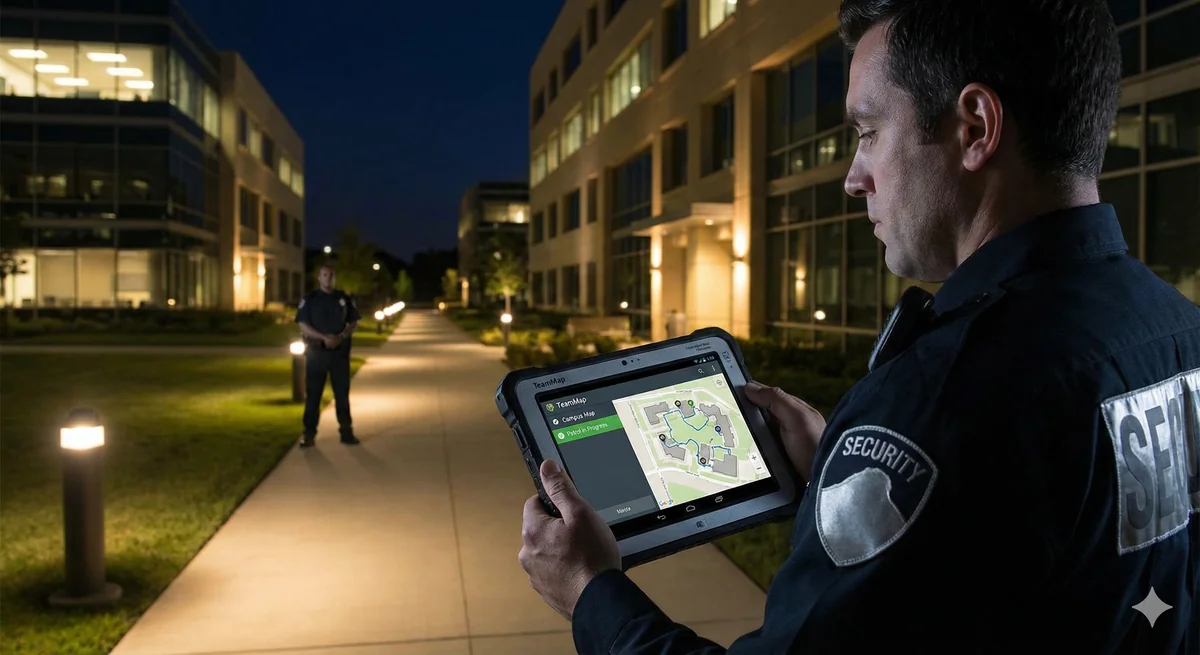
GPS-verified patrols provide the objective proof that increasingly skeptical clients demand. Patrol routes with timestamps demonstrate exactly where guards went and when. Time spent at each checkpoint shows whether guards actually checked the area or merely passed through. Historical data for any date and time allows clients to verify service delivery after the fact. This capability matters enormously to clients who have been burned by previous providers whose guards didn't actually patrol—and many clients have exactly this experience.
Digital reporting demonstrates professionalism and competence that paper-based systems cannot match. Photos captured at the scene provide evidence that supports written descriptions. Automatic timestamp and location data eliminates questions about when and where incidents occurred. Structured report formats ensure consistency across all guards and incidents. Immediate availability—reports accessible within minutes rather than days—enables clients to respond to situations in real time.
Client portal access signals confidence in your service quality. Providing real-time guard location visibility shows you have nothing to hide about guard positioning. Patrol completion status lets clients verify service delivery without calling to ask. Incident reports available as they're filed demonstrates transparency and responsiveness. Analytics and trend reports help clients understand their security situation and the value you provide over time.
Presenting Technology Effectively in Proposals
Don't just list features—feature lists read like technical specifications that fail to resonate with decision-makers. Instead, explain benefits in language that connects to client concerns. Saying "You'll receive incident reports within minutes, not days" speaks to frustration with slow information flow. Explaining that "GPS verification proves every patrol was completed as scheduled" addresses concerns about unverified services. Noting that "Your property manager can check guard locations in real time" emphasizes the control and visibility clients gain.
If you get a chance to present in person, demonstrate rather than describe. Show the mobile app that guards actually use in the field—seeing is believing. Walk through a sample incident report to illustrate the quality and detail clients will receive. Display the client portal view so decision-makers can envision accessing their own property's information. Share sample analytics reports that show the kind of insights they'll gain over time. Live demonstrations make capabilities tangible in ways that written proposals cannot.
Addressing Price Objections
When competing against cheaper bids from technology-free competitors, don't simply defend your price—reframe the conversation around value and risk. Ask what happened with their previous provider that led them to seek new bids. Often the answer reveals frustrations with service quality that your technology directly addresses.
Quantify the risk of unverified patrols by discussing what happens when incidents occur at times guards were supposed to be present but weren't. The cost of a single major incident—theft, liability claim, property damage—dwarfs any savings from cheaper unverified services. Offer trial periods that let clients experience the difference before committing to long-term contracts.
Perhaps most effectively, show the total cost including their management time. Cheap security that requires constant follow-up, complaint handling, and verification isn't actually cheap when you factor in the client's time spent managing problems. Professional technology-backed services reduce this hidden cost dramatically.
Key Takeaways
- Modern clients expect verification, accountability, professional reporting, and compliance documentation.
- GPS-verified patrols provide objective proof of service delivery that skeptical clients demand.
- Demo your technology during presentations—don't just describe features in written proposals.
- Compete on total value including reduced client management time, not just hourly rate.
Continue Reading

Video Analytics for Security: Beyond Basic Surveillance
AI-powered video analytics can detect intrusions, count people, and identify anomalies. This guide covers practical applications and integration strategies.
Florida Security Guard License Application: Division of Licensing Guide
Navigate the Florida Division of Licensing application process for security guards, including background checks, training providers, and processing timelines.

The 10 Best Security Guard Management Software Solutions in 2026
From enterprise platforms to mobile-first apps, we review the top security guard software options. Honest assessments of features, pricing, and who each solution works best for.